

Remodeling or Remodelling Which Spelling Is Correct can shape scope, cost, permits, materials, and timing. This guide helps homeowners compare practical remodeling decisions before the next step.
For outside planning context, ICC building safety resources can help compare building safety context before final remodeling decisions are made.
Both “remodeling” and “remodelling” are correct, but the right one depends on where you live. In the United States, “remodeling” with one L is the standard spelling. In the United Kingdom, Canada, and Australia, “remodelling” with two Ls is the accepted form.
This small spelling difference causes real confusion for homeowners researching renovation projects, comparing contractor quotes, or reading through permit documents. Using the wrong version can even affect your online search results when looking for local professionals.
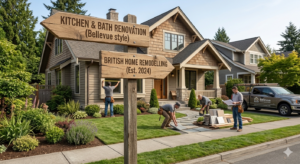
This guide explains why two spellings exist, which one to use in the US, and how the terminology connects to what actually matters: planning and budgeting your home remodel with confidence.
The Short Answer: Remodeling vs. Remodelling
If you are in the United States, the correct spelling is “remodeling” with one L. If you are in the United Kingdom, Australia, or Canada, the correct spelling is “remodelling” with two Ls.
Both spellings refer to the same thing: the process of changing the structure, layout, or design of an existing space. Neither version is “wrong” in a universal sense. The difference is purely regional. American English simplifies the doubled consonant, while British English retains it.
For homeowners in Bellevue, WA, and anywhere else in the US, “remodeling” is the spelling you will see on contractor websites, building permits, real estate listings, and home improvement publications. It is the version recognized by every major American dictionary, including Merriam-Webster.
Why Are There Two Spellings?
The split between “remodeling” and “remodelling” traces back to differences between American English and British English that were formalized in the early 1800s. These differences affect dozens of words, not just this one.
American English: Remodeling
American English follows spelling conventions largely influenced by Noah Webster, who published his first dictionary in 1806. Webster deliberately simplified many British spellings to create a distinct American standard. One of his consistent rules: when adding a suffix like “-ing” to a verb ending in a consonant, American English does not double the final consonant if the last syllable is unstressed.
“Remodel” has its stress on the second syllable (re-MOD-el), but the final syllable “-el” is unstressed. So American English keeps it simple: remodel becomes remodeling, remodeled, remodeler.
This same pattern applies to other words. “Travel” becomes “traveling” in American English. “Cancel” becomes “canceled.” The rule is consistent.
British English: Remodelling
British English follows a different convention. Regardless of syllable stress, British spelling typically doubles the final L before adding a suffix. So “remodel” becomes “remodelling,” “remodelled,” and “remodeller.”
This is the same reason British English uses “travelling,” “cancelled,” and “labelling.” The double-L convention is standard across the UK, Australia, New Zealand, and most of Canada.
Neither system is more “correct” than the other. They are simply different standards maintained by different English-speaking regions.
Which Spelling Should You Use in the United States?
Use “remodeling” with one L. This is not a matter of preference. It is the American English standard.
Every major US institution uses this spelling. The National Association of Home Builders uses “remodeling.” The National Association of the Remodeling Industry (NARI) uses it in their name. Building codes, permit applications, and real estate documents across Washington State all use “remodeling.”
If you are a homeowner in Bellevue or anywhere in the Pacific Northwest, using “remodeling” ensures consistency with local contractors, legal documents, and industry resources. It also ensures your online searches return the most relevant local results.
The only time you might encounter “remodelling” in the US is when reading content from international sources, imported publications, or websites based in the UK or Australia.
Does Spelling Matter When Planning a Home Remodel?
It might seem like a trivial detail, but the spelling you use can have practical consequences during a remodeling project. Here is where it actually matters.
Searching for Contractors and Quotes
When you search online for a remodeling contractor, search engines prioritize results based on the exact terms you type. Searching “remodelling contractors Bellevue” with two Ls may return fewer local results or pull in content from international sources. Searching “remodeling contractors Bellevue” with one L connects you directly to US-based professionals who serve your area.
This applies to every related search: “kitchen remodeling cost,” “bathroom remodeling near me,” “whole home remodeling Bellevue.” Consistent American spelling gives you better, more relevant results.
Reading Contracts, Permits, and Legal Documents
Building permits issued by the City of Bellevue and contracts drafted by licensed Washington State contractors will use “remodeling.” If you are reviewing a contract that uses “remodelling,” it may indicate the document was templated from an international source. That is not necessarily a problem, but it is worth noting for consistency and professionalism.
Communicating With Your Remodeling Team
Clear communication is one of the most important factors in a successful remodel. Using consistent terminology, including correct spelling, helps avoid confusion in emails, project scopes, change orders, and written approvals. It is a small detail that reflects attention to the larger process.
Common Spelling Variations in Home Renovation
The remodeling/remodelling question is just one of several terminology confusions homeowners encounter. Understanding the differences helps you communicate more effectively with contractors and make better decisions.
Remodel vs. Remodeling vs. Remodelling
“Remodel” is the base verb and also functions as a noun (as in “a kitchen remodel”). “Remodeling” is the present participle and gerund form used in American English. “Remodelling” is the same form in British English.
All three refer to the same activity: altering the structure, form, or appearance of an existing space. When you see “home remodel,” “home remodeling,” or “remodeling project,” they all describe the same type of work.
Renovation vs. Remodeling
These two terms are often used interchangeably, but they have distinct meanings in the construction industry.
Renovation means restoring or updating a space without changing its fundamental structure or layout. Repainting walls, refinishing hardwood floors, and replacing fixtures are renovations. The room stays the same shape and serves the same purpose.
Remodeling means changing the structure, layout, or purpose of a space. Removing a wall between a kitchen and dining room, converting a garage into a bedroom, or reconfiguring a bathroom layout are all remodeling projects. Remodeling typically involves more extensive work, higher costs, and often requires building permits.
For budgeting purposes, this distinction matters. A renovation might cost $15,000 to $50,000 depending on scope, while a full remodel of the same space could range from $50,000 to $150,000 or more based on structural changes, materials, and labor in the Bellevue market.
Other Commonly Confused Construction Terms
A few other terms cause similar confusion:
Restoration refers to returning a space to its original condition, often used with historic homes. Addition means building new square footage onto an existing structure. Retrofit means adding new systems or technology to an older building, such as seismic upgrades or energy-efficient insulation.
Knowing these distinctions helps you describe your project accurately when requesting quotes, which leads to more precise estimates and fewer surprises.
How Bellevue Homeowners Use the Right Terminology
In the Bellevue, WA market, the terminology you use signals your familiarity with the process. Local contractors, architects, and permit offices all use American English conventions. “Remodeling” is standard on every permit application, contractor license, and project proposal in King County.
Bellevue’s construction market is competitive. According to the U.S. Census Bureau’s Building Permits Survey, the Seattle-Bellevue metro area consistently ranks among the top regions for residential construction activity. Homeowners here are often well-informed and detail-oriented, which means contractors expect clear, precise communication from the start.
Using the correct terminology also matters when researching costs specific to this market. Bellevue’s cost of living and construction labor rates are higher than national averages. Searching with the right spelling and terms ensures you find data relevant to your actual location rather than generic national figures.
What Really Matters: Planning Your Remodeling Project
Now that the spelling question is settled, the real work begins. Whether you call it remodeling or remodelling, the success of your project depends on planning, budgeting, and choosing the right team.
Setting a Realistic Budget
Every remodeling project starts with a budget, and the most common mistake homeowners make is underestimating costs. A realistic budget accounts for the full scope of work, not just the visible finishes.
For a whole-home remodel in Bellevue, costs typically range from $100 to $250 per square foot depending on the level of finishes, structural changes, and complexity. A mid-range kitchen remodel might run $40,000 to $80,000, while a high-end kitchen with custom cabinetry and premium appliances can exceed $150,000.
The best approach is to define your priorities first. Decide which rooms or changes matter most, then allocate your budget accordingly. A good contractor will help you understand where your money goes and where you can adjust without sacrificing quality.
Understanding Labor, Materials, and Permit Costs
Labor is typically the largest single expense in a remodeling project, often accounting for 40% to 60% of the total budget. In the Bellevue market, skilled tradespeople command premium rates due to high demand and cost of living.
Materials vary widely based on your selections. Stock cabinetry versus custom, laminate versus quartz countertops, standard fixtures versus designer options. Each choice shifts the budget significantly.
Permits are required for most remodeling work in Bellevue that involves structural changes, electrical work, plumbing modifications, or changes to the building envelope. Permit fees vary by project scope but typically range from a few hundred to several thousand dollars. Skipping permits is never worth the risk. Unpermitted work can create legal issues, complicate future sales, and void insurance coverage.
Avoiding Hidden Expenses and Budget Overruns
Hidden costs are the number one source of budget stress in remodeling. The most common surprises include:
Structural issues discovered after demolition, such as water damage, outdated wiring, or insufficient framing. These are impossible to predict with certainty until walls are opened.
Scope changes during the project. Adding a feature or upgrading a material mid-construction almost always costs more than including it in the original plan.
Temporary living expenses if the remodel makes your home uninhabitable during construction. For whole-home remodels, this can add thousands to the total cost.
The best defense against hidden costs is a thorough pre-construction assessment, a detailed written scope of work, and a contingency budget of 10% to 20% above your base estimate. An experienced contractor will walk you through potential risks before work begins, not after surprises appear.
For related planning details, compare Home Remodeling in Bellevue.
For related planning details, compare How Long Should A Remodel Take Realistic Timelines By Project Type.
For budget planning, compare Luxury Home Remodeling Cost in Bellevue: Whole-Home Scope, Phasing & Timeline.
Conclusion
“Remodeling” is the correct spelling in the United States. “Remodelling” is correct in British English. For homeowners in Bellevue, WA, using the American spelling ensures consistency across contractor searches, permit documents, contracts, and every stage of your renovation project.
But spelling is just the starting point. What truly determines the success of your project is clear planning, realistic budgeting, and working with a contractor who communicates transparently from the first conversation through the final walkthrough.
We built BLC Remodeling around that principle. If you are planning a remodel in Bellevue and want a team that delivers honest pricing, expert construction, and results built for long-term value, contact us today to start the conversation.
Frequently Asked Questions
Is it remodeling or remodelling in the US?
In the United States, “remodeling” with one L is the correct and standard spelling. This follows American English conventions established in the early 1800s. All US contractors, building codes, and industry organizations use this spelling.
Why do some websites spell it remodelling with two Ls?
Websites based in the United Kingdom, Australia, Canada, or other countries that follow British English conventions use “remodelling” with two Ls. If you see this spelling on a US-based site, it is likely a typographical error or a template sourced from an international provider.
Does the spelling of remodeling affect my contractor search?
Yes, it can. Search engines return results based on the exact terms you use. Searching “remodeling” in the US will return more relevant local contractor listings, cost guides, and project examples than searching “remodelling,” which may pull in international content.
What is the difference between remodeling and renovation?
Renovation means updating or restoring a space without changing its structure or layout. Remodeling means altering the structure, layout, or function of a space. Remodeling is typically more extensive, more expensive, and more likely to require building permits.
How much does a home remodel cost in Bellevue, WA?
Costs vary widely based on scope, materials, and complexity. In Bellevue, whole-home remodels typically range from $100 to $250 per square foot. A mid-range kitchen remodel might cost $40,000 to $80,000, while high-end projects can exceed $150,000.
What are the most common hidden costs in a remodeling project?
The most common hidden costs include structural damage discovered during demolition, scope changes made mid-project, permit fees, and temporary living expenses during construction. A contingency budget of 10% to 20% helps absorb these surprises.
How do I choose the right remodeling contractor in Bellevue?
Look for a licensed, bonded, and insured contractor with experience in your specific type of project. Ask for detailed written estimates, check references, verify their history with the Washington State Department of Labor & Industries, and prioritize contractors who communicate clearly and offer transparent pricing.
Questions homeowners ask about Remodeling or Remodelling: Which Spelling Is Correct
Use these answers to compare scope, scheduling, selections and the details that usually shape a smoother remodeling conversation.
Why do existing conditions matter for Remodeling or Remodelling: Which Spelling Is Correct?
The first review should connect the desired result with the home’s current layout, access, materials, utilities and finish expectations. BLC Remodeling uses that early review to separate simple design preferences from construction details that may affect timing or coordination.
How should timing be discussed for Remodeling or Remodelling: Which Spelling Is Correct?
Schedule and selections are closely connected because materials, trade sequencing, inspections and access can change how work should move forward. A clear plan helps homeowners understand which choices need attention early and which decisions can wait until the scope is better defined.
What helps keep Remodeling or Remodelling: Which Spelling Is Correct organized?
Existing conditions should be checked before final selections are ordered or construction timing is assumed. That review may include framing, waterproofing, ventilation, electrical needs, finish transitions, site access and the way daily routines should be protected during the work.
What should happen before final decisions are made for Remodeling or Remodelling: Which Spelling Is Correct?
The most useful next step is a practical conversation with BLC Remodeling about the home, the intended outcome and the details that could influence scope. From there, the team can identify the right service path and the questions that deserve a closer look.