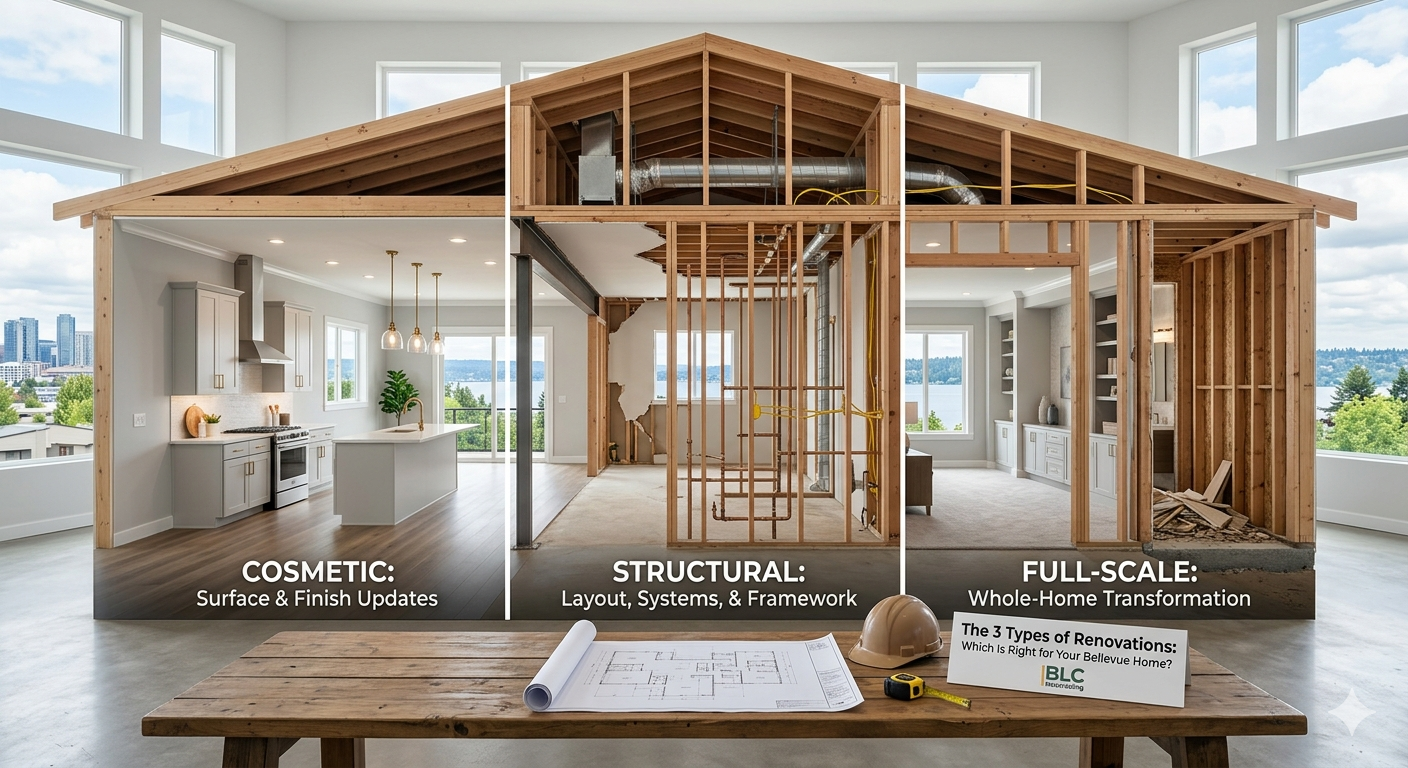
Every home renovation falls into one of three categories: cosmetic, structural, or full-scale. Knowing which type matches your goals, budget, and property condition is the single most important step before you spend a dollar on your remodel.
Too many Bellevue homeowners jump into a renovation without understanding the scope they actually need. The result is mismatched expectations, surprise costs, and projects that stall halfway through. Whether you are refreshing a dated kitchen, reinforcing a load-bearing wall, or gutting an entire home down to the studs, the planning process starts with identifying the right renovation type.
This guide breaks down all three renovation categories, including realistic cost ranges for the Bellevue, WA market, the key factors that drive pricing, and a clear framework for deciding which approach fits your home, your timeline, and your budget.
What Are the 3 Types of Home Renovations?
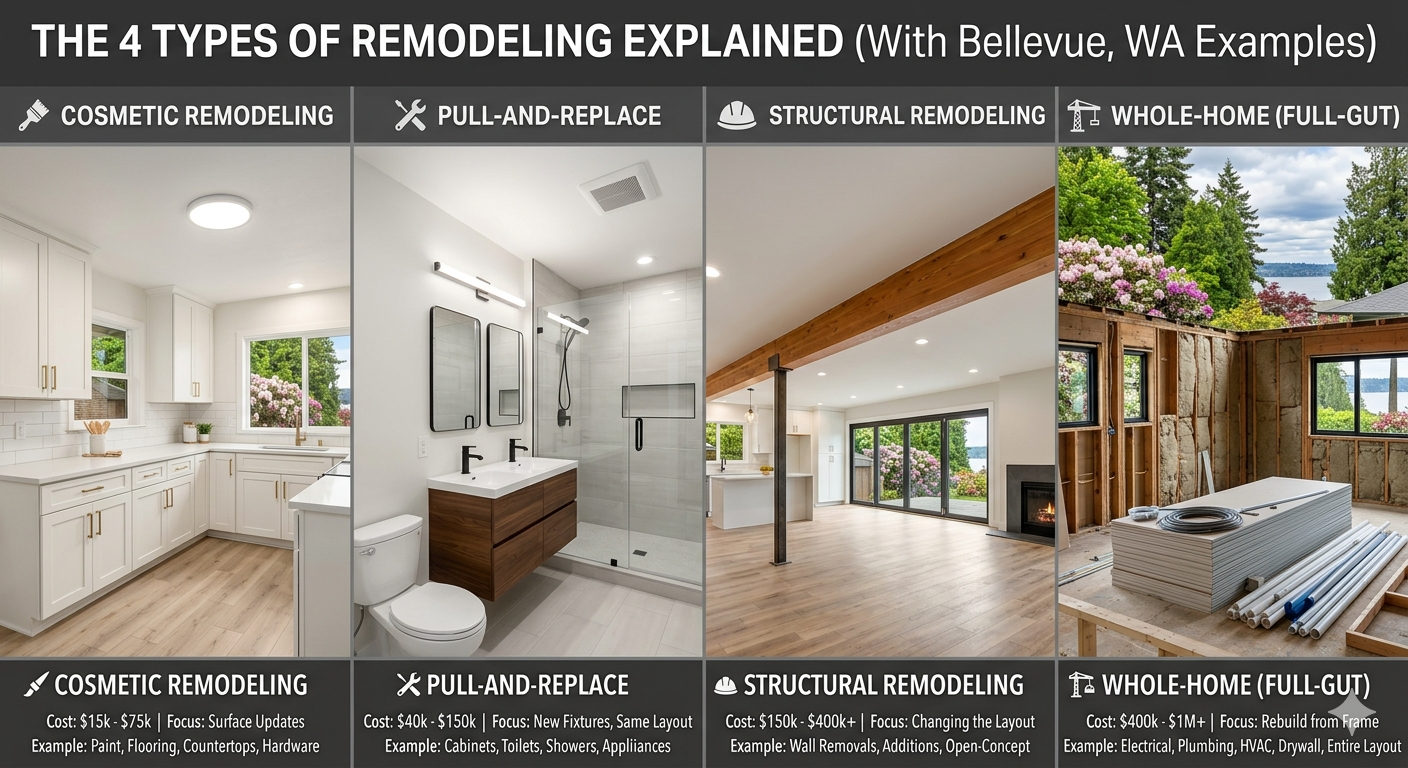
Not all renovations are created equal. The scope, cost, timeline, and complexity of a remodeling project depend entirely on which type of renovation you are undertaking. Understanding these three categories gives you a shared language with your contractor and a realistic foundation for budgeting.
Cosmetic Renovations
A cosmetic renovation updates the visible surfaces and finishes of your home without altering its structure, layout, or mechanical systems. Think of it as changing what you see and touch. Paint, flooring, countertops, cabinet refacing, lighting fixtures, and hardware swaps all fall into this category.
Cosmetic projects rarely require permits. They typically involve shorter timelines, lower labor costs, and minimal disruption to daily life. For homeowners who are happy with their floor plan but want a fresher, more modern look, cosmetic renovations deliver noticeable impact at a fraction of the cost of deeper work.
Structural Renovations
A structural renovation changes the bones of your home. This includes removing or adding walls, modifying the roofline, expanding the footprint with an addition, reinforcing the foundation, or reconfiguring the layout. Structural work also covers major system upgrades like replacing electrical panels, re-plumbing an entire bathroom, or installing new HVAC ductwork.
These projects require engineering assessments, building permits, and inspections from the City of Bellevue. They take longer, cost more, and demand experienced contractors who understand local building codes and structural load requirements. The payoff is a home that functions differently, not just one that looks different.
Full-Scale (Whole-Home) Renovations
A full-scale renovation combines cosmetic and structural work across most or all of the home. This is the gut remodel. Walls come down, systems get replaced, layouts change, and every surface is refinished. Whole-home renovations are common when purchasing a fixer-upper, converting a property for a new use, or modernizing a home that has not been updated in decades.
Full-scale projects are the most complex, the most expensive, and the most rewarding when executed well. They require detailed project planning, phased construction schedules, and a contractor who can coordinate multiple trades simultaneously.
Cosmetic Renovations: Scope, Costs, and Best Fit
Cosmetic renovations are the most accessible entry point for homeowners who want visible improvement without the complexity of structural work. They are also the fastest way to increase a home’s appeal before listing it for sale.
What Counts as a Cosmetic Renovation?
Cosmetic work targets surfaces and fixtures. Common cosmetic renovation projects include:
- Interior and exterior painting
- Replacing flooring (hardwood, tile, LVP)
- Updating countertops and backsplashes
- Refacing or repainting cabinets
- Swapping out lighting fixtures, faucets, and hardware
- Installing new trim, molding, or wainscoting
- Upgrading appliances (when no electrical or plumbing changes are needed)
- Refreshing landscaping and curb appeal elements
The defining characteristic is that cosmetic renovations do not change the layout, structure, or mechanical systems of the home. If you are not moving walls, rerouting plumbing, or pulling permits, you are likely in cosmetic territory.
Typical Cost Ranges for Cosmetic Updates in Bellevue
Bellevue’s cost of living and labor rates sit well above the national average. For cosmetic renovations, homeowners should expect to invest between $15,000 and $75,000 depending on the number of rooms, material quality, and finish level.
A single-room refresh like a bathroom vanity replacement with new tile and paint might run $5,000 to $15,000. A full cosmetic update across a 2,000-square-foot home, including new flooring, paint, lighting, and kitchen surface upgrades, can reach $50,000 to $75,000 with mid-range to high-end finishes.
Material selection is the biggest variable. The difference between laminate countertops and quartz, or between builder-grade LVP and engineered hardwood, can shift your budget by thousands per room.
Who Should Choose a Cosmetic Renovation?
Cosmetic renovations are the right fit if your home’s layout works well, the structure is sound, and the mechanical systems are in good condition. You are a strong candidate for cosmetic work if:
- You like your floor plan but the finishes feel dated
- You are preparing to sell and want to maximize curb appeal and buyer interest
- Your budget is under $75,000 and you want the most visible impact per dollar
- You need the project completed quickly, often within two to six weeks
- You are an investor looking to flip or refresh a rental property between tenants
Cosmetic renovations deliver the highest visual return for the lowest investment. They do not solve functional problems, but they are unmatched for transforming how a home looks and feels.
Structural Renovations: Scope, Costs, and Best Fit
When your home’s layout, systems, or foundation no longer meet your needs, cosmetic updates will not solve the problem. Structural renovations address the functional core of your home.
What Counts as a Structural Renovation?
Structural renovations involve changes to the home’s framework, layout, or major systems. Common structural projects include:
- Removing or relocating load-bearing walls
- Adding a room, bump-out, or second story
- Converting a garage, attic, or basement into living space
- Replacing the roof structure or modifying the roofline
- Foundation repair or reinforcement
- Full electrical rewiring or panel upgrades
- Re-plumbing a kitchen or bathroom
- Installing or replacing HVAC systems and ductwork
- Widening doorways or hallways for accessibility
Structural work changes how your home is built, not just how it looks. It almost always requires permits from the City of Bellevue, structural engineering plans, and inspections at multiple stages.
Typical Cost Ranges for Structural Projects in Bellevue
Structural renovations in Bellevue typically range from $75,000 to $250,000 or more, depending on the scope. A single structural project like removing a load-bearing wall and installing a beam might cost $10,000 to $25,000 on its own. But most homeowners pursuing structural work are tackling multiple changes at once, such as opening up a kitchen, reconfiguring a bathroom, and upgrading the electrical system.
A major kitchen remodel with wall removal, new plumbing, electrical upgrades, and custom cabinetry often lands between $80,000 and $150,000 in the Bellevue market. Adding a room or second-story addition can push costs to $200,000 to $400,000 depending on square footage and finish level.
Labor is a larger share of the budget in structural work. You are paying for licensed electricians, plumbers, structural engineers, and general contractors who manage complex sequencing across trades. In Bellevue, skilled trade labor rates reflect the region’s high demand and cost of living.
Who Should Choose a Structural Renovation?
Structural renovations are the right choice when your home’s current layout or systems prevent it from meeting your needs. You should consider structural work if:
- Your floor plan does not function for how your family lives today
- You need more space but do not want to move
- Your electrical, plumbing, or HVAC systems are outdated or failing
- You want to add an ADU (accessory dwelling unit) or convert unused space
- Your home has foundation issues, water intrusion, or structural damage
- You are planning to stay in the home for five or more years and want long-term value
Structural renovations cost more and take longer, but they solve problems that cosmetic work cannot touch. They also tend to deliver strong long-term ROI, especially in a high-value market like Bellevue where functional square footage commands a premium.
Full-Scale Renovations: Scope, Costs, and Best Fit
A full-scale renovation is the most comprehensive approach. It combines structural changes with complete cosmetic finishing across the entire home. This is the path for homeowners and investors who want to transform a property from the inside out.
What Counts as a Full-Scale Renovation?
Full-scale renovations involve gutting most or all of the home and rebuilding it. The scope typically includes:
- Demolition down to studs (and sometimes to the foundation)
- Complete layout reconfiguration
- All new electrical, plumbing, and HVAC systems
- Structural modifications (walls, beams, foundation work)
- New insulation, drywall, and framing as needed
- All new finishes: flooring, cabinetry, countertops, fixtures, paint
- Updated windows and doors
- Exterior improvements (siding, roofing, landscaping)
In a full-scale remodel, every trade is involved. The project requires detailed architectural plans, engineering review, multiple permit applications, and a phased construction schedule that can span several months.
Typical Cost Ranges for Whole-Home Remodels in Bellevue
Whole-home renovations in Bellevue generally start around $150,000 for smaller homes with moderate finishes and can exceed $500,000 or more for larger properties with high-end materials and complex structural changes.
A reasonable benchmark for the Bellevue market is $150 to $350 per square foot for a full gut remodel, depending on the condition of the existing structure, the extent of structural work, and the quality of finishes selected. For a 2,500-square-foot home, that translates to a range of roughly $375,000 to $875,000.
These numbers reflect the reality of building in the Puget Sound region: higher labor costs, stringent energy code requirements, and material pricing that trends above national averages. The wide range exists because finish selections, from standard to luxury, can double the cost of the same square footage.
Who Should Choose a Full-Scale Renovation?
Full-scale renovations make sense in specific situations where partial work would be inefficient or insufficient. You are a strong candidate for a whole-home remodel if:
- You purchased a fixer-upper or estate property that needs everything
- Your home is structurally sound but functionally obsolete in layout, systems, and finishes
- You want to stay in a neighborhood you love but your home no longer fits your lifestyle
- You are an investor converting a property for resale or rental at a higher price point
- Piecemeal renovations over the years have created inconsistencies you want to resolve in one project
- You are willing to invest in a longer timeline (typically four to twelve months) for a complete transformation
Full-scale renovations are the most disruptive and the most expensive. They also deliver the most dramatic results. When planned and executed well, a whole-home remodel can effectively give you a new home on your existing lot, built exactly to your specifications.
How to Decide Which Renovation Type Is Right for Your Home
Choosing between cosmetic, structural, and full-scale renovation is not just about budget. It is about matching the right scope to your home’s condition, your goals, and your timeline.
Assess Your Home’s Current Condition
Start with an honest evaluation of what your home needs. Walk through every room and note what is cosmetic (outdated finishes, worn surfaces) versus what is functional (poor layout, failing systems, structural concerns).
If the bones are good and the systems work, cosmetic renovation is likely sufficient. If you are dealing with knob-and-tube wiring, galvanized plumbing, a cracked foundation, or a layout that wastes space, you are looking at structural work. If the answer to most questions is “it all needs to go,” a full-scale remodel is the most efficient path.
A professional home assessment from a qualified contractor can help you distinguish between what looks bad and what is actually broken. This step alone can save you tens of thousands of dollars by preventing over-renovation or under-renovation.
Define Your Goals: Comfort, Value, or Both?
Your renovation goals shape the type of work you need.
If your primary goal is comfort and aesthetics, cosmetic renovations often deliver the most satisfaction per dollar. New finishes, better lighting, and updated fixtures make a home feel new without the complexity of construction.
If your goal is functional improvement, such as a better kitchen layout, more living space, or modern mechanical systems, structural renovation is the right tool.
If your goal is total transformation, whether for personal use or investment return, a full-scale renovation gives you the most control over the final result.
Many homeowners want both comfort and value. In that case, the decision comes down to how much of the home needs to change to achieve both goals.
Match Your Budget to the Right Scope
One of the most common renovation mistakes is choosing a scope that does not match the available budget. A structural renovation budget applied to a full-scale project will run out before the work is finished. A full-scale budget spent on cosmetic work alone may over-improve the home beyond what the neighborhood supports.
Use these general Bellevue benchmarks as a starting framework:
- Under $75,000: Cosmetic renovation (one to several rooms)
- $75,000 to $250,000: Structural renovation (major system or layout changes)
- $250,000 and above: Full-scale renovation (whole-home gut remodel)
These ranges overlap intentionally. A high-end cosmetic renovation can cost as much as a modest structural project. The key is aligning your budget with the type of work that addresses your most important needs first.
When to Combine Renovation Types
Renovations do not always fit neatly into one category. Many successful projects blend types. You might do structural work in the kitchen (removing a wall, upgrading plumbing) while keeping the rest of the home cosmetic (new paint, flooring, fixtures).
Combining types is often the smartest approach for homeowners who have a specific functional problem in one area but are otherwise happy with their home. It lets you invest heavily where it matters most and spend efficiently everywhere else.
The key is planning the combined scope upfront. Discovering structural needs mid-project, after you have already committed your budget to cosmetic finishes, is one of the most common causes of cost overruns.
Key Cost Factors That Apply to Every Renovation Type
Regardless of whether you are doing cosmetic, structural, or full-scale work, certain cost drivers affect every project. Understanding these factors helps you build a more accurate budget and avoid surprises.
Labor and Contractor Pricing in Bellevue
Labor is typically the largest single expense in any renovation, often accounting for 40% to 60% of the total project cost. In Bellevue and the greater Eastside, labor rates are among the highest in the Pacific Northwest due to strong demand, a competitive skilled trades market, and the region’s high cost of living.
General contractors in Bellevue typically charge between 15% and 25% of the total project cost as their fee, which covers project management, scheduling, subcontractor coordination, and oversight. Specialized trades like electricians, plumbers, and structural engineers bill separately, and their rates reflect licensing requirements and regional demand.
Getting multiple detailed quotes is essential. But the lowest bid is not always the best value. Look for contractors who provide transparent, itemized estimates that break down labor, materials, permits, and contingency so you can compare scope, not just price.
Materials and Finish Selections
Material costs vary dramatically based on quality, brand, and availability. The difference between standard and premium materials can double or triple the cost of the same project.
For example, kitchen cabinetry alone can range from $5,000 for stock cabinets to $40,000 or more for custom-built options. Flooring ranges from $3 to $15+ per square foot installed, depending on whether you choose LVP, engineered hardwood, or solid hardwood.
In Bellevue, many homeowners select mid-range to high-end finishes to match the expectations of the local real estate market. This is a smart strategy for resale value, but it requires careful budgeting. Your contractor should help you identify where premium materials deliver real value and where mid-range options perform just as well.
Permits, Inspections, and Code Compliance
Any renovation that involves structural changes, electrical work, plumbing modifications, or changes to the building envelope will require permits from the City of Bellevue. Permit costs vary by project scope but typically range from $500 to $5,000+ for residential work.
The permitting process adds time to your project timeline. In Bellevue, permit review can take anywhere from a few weeks to several months depending on the complexity of the project and current department workload. Your contractor should factor this lead time into the overall project schedule.
Skipping permits is never worth the risk. Unpermitted work can create legal liability, complicate future sales, void insurance coverage, and result in costly corrections if discovered during inspection.
Washington State’s energy code requirements are also among the most stringent in the country. Renovations that trigger code compliance thresholds may require additional insulation, window upgrades, or mechanical system improvements that add to the project cost but improve long-term energy efficiency.
Hidden Costs and Contingency Planning
Every renovation uncovers surprises. Behind walls, you may find outdated wiring, water damage, mold, asbestos-containing materials, or framing that does not meet current code. These discoveries are not failures of planning. They are a normal part of renovation work, especially in older Bellevue homes.
A well-planned budget includes a contingency reserve of 10% to 20% of the total project cost. Cosmetic renovations, which involve less demolition and fewer unknowns, can lean toward the lower end. Structural and full-scale renovations, where opening walls and floors is part of the process, should budget closer to 15% to 20%.
Other commonly overlooked costs include temporary housing during major renovations, storage for furniture and belongings, landscaping repair after construction, and the cost of design or architectural services for complex projects.
Renovation Type Comparison: Side-by-Side Breakdown
| Factor | Cosmetic Renovation | Structural Renovation | Full-Scale Renovation |
| Scope | Surfaces and finishes only | Layout, systems, or structural changes | Entire home, gut to finish |
| Typical Cost (Bellevue) | $15,000 – $75,000 | $75,000 – $250,000+ | $250,000 – $500,000+ |
| Timeline | 2 – 6 weeks | 2 – 6 months | 4 – 12 months |
| Permits Required | Rarely | Almost always | Always |
| Disruption Level | Low to moderate | Moderate to high | High (may require temporary relocation) |
| Best For | Dated finishes, pre-sale prep, quick refresh | Layout problems, system failures, additions | Obsolete homes, fixer-uppers, total transformation |
| ROI Potential | High for cost (cosmetic appeal) | High for function and value | Highest total value but requires largest investment |
| Complexity | Low | Moderate to high | High |
This table is a starting point. Your specific project may blend categories or fall between ranges. The most accurate way to understand your renovation cost is through a detailed scope review with a qualified contractor.
How to Budget for Your Renovation Project
Budgeting is where renovation success or failure begins. The right budget is not just a number. It is a plan that accounts for scope, priorities, contingencies, and realistic market pricing.
Setting a Realistic Budget by Renovation Type
Start by identifying your renovation type using the framework above. Then build your budget in layers:
Layer 1: Base scope. What is the minimum work required to achieve your primary goal? Price this first.
Layer 2: Desired upgrades. What additional improvements would you like if the budget allows? List these separately.
Layer 3: Contingency. Add 10% to 20% on top of your base scope for unknowns.
Layer 4: Soft costs. Include permits, design fees, temporary housing, and any other non-construction expenses.
This layered approach prevents the common mistake of spending the entire budget on finishes before accounting for the less visible but equally important costs like permits, engineering, and contingency.
Prioritizing Renovations for Maximum ROI
Not all renovations return equal value. In the Bellevue market, kitchens and bathrooms consistently deliver the strongest return on investment, whether you are renovating for personal enjoyment or resale.
If your budget does not cover everything you want, prioritize the spaces and systems that affect daily life the most. A functional, well-designed kitchen will deliver more value than a cosmetic update to a guest bedroom. Replacing a failing HVAC system will protect your home’s value more than new landscaping.
For investors, focus on renovations that increase usable square footage, improve energy efficiency, or bring the home up to the standard of comparable properties in the neighborhood. Over-improving beyond the neighborhood’s price ceiling is one of the most common investment mistakes.
Avoiding Budget Overruns: Practical Tips
Budget overruns are not inevitable. Most cost overruns trace back to one of these causes:
Unclear scope. If the project scope is not defined in detail before construction begins, changes and additions during the build will inflate costs. Invest time in planning upfront.
Skipping the contingency. Homeowners who allocate 100% of their budget to planned work have zero margin for surprises. Surprises will happen.
Scope creep. “While we’re at it” is the most expensive phrase in renovation. Every addition during construction costs more than it would have if planned from the start.
Choosing a contractor on price alone. The lowest bid often reflects missing scope, not better efficiency. Detailed, itemized proposals protect you from unexpected charges later.
Delaying decisions. Material selections, fixture choices, and design decisions made late in the process cause delays. Delays cost money. Make selections before construction begins whenever possible.
How BLC Remodeling Helps Bellevue Homeowners Choose the Right Renovation
Choosing the right renovation type is easier with an experienced partner. At BLC Remodeling, we work with Bellevue homeowners and property investors from the earliest planning stages, helping you assess your home’s condition, define your goals, and build a realistic budget before any construction begins.
Our process starts with a detailed scope review. We walk through your home, identify what is cosmetic versus structural, and provide transparent, itemized estimates so you understand exactly where your money goes. No hidden fees. No vague allowances. Just clear numbers tied to a clear plan.
Whether you need a targeted cosmetic refresh, a structural reconfiguration, or a complete whole-home remodel, we bring the construction expertise, project management discipline, and local market knowledge to keep your project on budget, on schedule, and built for long-term value.
Conclusion
Every renovation decision starts with understanding the three types of work available to you: cosmetic, structural, and full-scale. Matching the right type to your home’s condition, your goals, and your budget is the foundation of a successful remodel, whether you are refreshing finishes, reconfiguring your layout, or transforming your entire property.
Bellevue homeowners and investors who take the time to plan scope and budget before construction begins consistently achieve better results, fewer surprises, and stronger returns on their investment. The framework in this guide gives you the tools to make that plan with confidence.
We help Bellevue homeowners navigate every stage of the renovation process, from initial assessment to final walkthrough. If you are ready to determine which renovation type is right for your home, contact BLC Remodeling for a detailed consultation and transparent project estimate built around your goals.
Frequently Asked Questions
What is the difference between a cosmetic and structural renovation?
A cosmetic renovation updates visible surfaces and finishes like paint, flooring, countertops, and fixtures without changing the home’s layout or systems. A structural renovation alters the home’s framework, such as removing walls, adding square footage, or replacing electrical, plumbing, or HVAC systems. The key distinction is whether the work changes how the home looks (cosmetic) or how it is built and functions (structural).
How much does a full home renovation cost in Bellevue, WA?
A full-scale, whole-home renovation in Bellevue typically ranges from $250,000 to $500,000 or more, depending on the home’s size, condition, and finish level. A general benchmark is $150 to $350 per square foot for a gut remodel. Costs are higher than national averages due to Bellevue’s labor rates, material pricing, and stringent energy code requirements.
Do I need a permit for my renovation in Bellevue?
You need a permit for any work that involves structural changes, electrical modifications, plumbing alterations, or changes to the building envelope. Cosmetic updates like painting, flooring, and fixture swaps typically do not require permits. The City of Bellevue’s Development Services department reviews residential permit applications, and your contractor should handle the submission and inspection process.
How long does each type of renovation take?
Cosmetic renovations typically take two to six weeks. Structural renovations range from two to six months depending on scope and permit timelines. Full-scale whole-home remodels generally require four to twelve months from demolition to completion. Permit review times in Bellevue can add several weeks to structural and full-scale project timelines.
Which renovation type gives the best return on investment?
Cosmetic renovations offer the highest ROI relative to cost because they deliver visible impact at a lower price point, making them ideal for pre-sale preparation. Structural renovations that add usable square footage or modernize major systems also deliver strong returns in Bellevue’s high-value market. Full-scale renovations generate the highest total value increase but require the largest upfront investment.
How do I know if my home needs structural work or just cosmetic updates?
If your home’s layout functions well, the roof and foundation are sound, and the electrical, plumbing, and HVAC systems are in good working condition, cosmetic updates are likely sufficient. Signs that structural work is needed include cracked foundations, outdated wiring (knob-and-tube), galvanized plumbing, poor layout flow, or the desire to add space. A professional assessment from a qualified contractor is the most reliable way to determine what your home actually needs.
How much contingency should I include in my renovation budget?
Plan for a contingency reserve of 10% to 20% of your total project budget. Cosmetic renovations with fewer unknowns can lean toward 10%. Structural and full-scale renovations, where opening walls and floors often reveals hidden conditions like water damage, outdated wiring, or code deficiencies, should budget 15% to 20%. This reserve is not optional. It is a standard part of responsible renovation planning.