

Types of Remodeling Explained can shape scope, cost, permits, materials, and timing. This guide helps homeowners compare practical remodeling decisions before the next step.
For outside planning context, CPSC home safety guidance can help compare home safety planning before final remodeling decisions are made.
Not every remodeling project requires tearing your home down to the studs. There are actually four distinct types of remodeling, each with different scopes, timelines, and price points, and choosing the wrong one is one of the fastest ways to blow your budget.
Whether you’re refreshing a dated kitchen or reconfiguring your entire floor plan, understanding these four categories helps you set realistic cost expectations and hire the right contractor. This is especially true in Bellevue, WA, where labor rates and permit requirements can shift project costs significantly.
This guide breaks down each remodeling type with real examples, Bellevue-area cost ranges, and practical advice for matching the right scope to your goals and budget.
What Are the 4 Types of Remodeling?
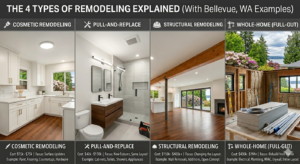
Before you request quotes or set a renovation budget, you need to understand what category your project falls into. The four types of remodeling represent a spectrum from surface-level updates to complete home transformations. Each type involves different trades, different permit requirements, and very different price tags.
Here’s a quick overview before we go deep on each one.
Cosmetic Remodeling
Cosmetic remodeling is the lightest level of renovation. It focuses on surface finishes and visual upgrades without changing the layout, structure, or mechanical systems of your home. Think of it as changing what you see and touch: paint, flooring, hardware, light fixtures, and countertops.
No walls come down. No plumbing gets rerouted. The “bones” of the room stay exactly where they are.
Pull-and-Replace Remodeling
Pull-and-replace remodeling removes existing fixtures and materials and installs new ones in the same locations. A kitchen pull-and-replace, for example, means your new cabinets, sink, and appliances go right where the old ones were. The layout doesn’t change, but the quality and condition of every component does.
This type often involves plumbing and electrical connections but typically stays within the existing footprint.
Structural Remodeling
Structural remodeling changes the physical layout or load-bearing elements of your home. This includes removing or relocating walls, adding rooms, expanding footprints, or modifying rooflines. It’s the category where architects, structural engineers, and building permits become essential parts of the process.
If your project involves the phrase “open up this space” or “add a second story,” you’re looking at structural work.
Whole-Home (Full-Gut) Remodeling
Whole-home remodeling strips a house down to its frame and rebuilds from there. Every system gets replaced or upgraded: electrical, plumbing, HVAC, insulation, drywall, finishes. It’s the most comprehensive and expensive type of remodel, but it’s also the only option when a home’s systems are outdated beyond repair or when you want to completely reimagine the layout.
This is common in Bellevue with older homes from the 1950s through 1970s that have solid foundations but need everything else brought up to modern standards.
Cosmetic Remodeling Explained
Cosmetic remodeling is where most homeowners start, and for good reason. It delivers the most visible change per dollar spent. You’re upgrading the surfaces and finishes that you interact with daily without disrupting the underlying structure or systems of your home.
The key distinction is that cosmetic work doesn’t require permits in most Bellevue jurisdictions because you’re not altering electrical circuits, plumbing lines, or structural elements.
What Cosmetic Remodeling Includes
A cosmetic remodel typically covers:
- Interior painting and wallpaper
- New flooring (hardwood, tile, luxury vinyl plank)
- Cabinet refacing or repainting (not replacing)
- Countertop replacement on existing cabinets
- Updated hardware (drawer pulls, door handles, hinges)
- Light fixture swaps (using existing wiring and junction boxes)
- New backsplash tile
- Bathroom vanity replacement (same plumbing location)
- Trim and molding upgrades
The common thread is that nothing behind the walls changes. You’re working on the finish layer only.
Example: A Bellevue homeowner with a 1990s kitchen replaces laminate countertops with quartz, repaints the existing oak cabinets in a modern white, installs new brushed-brass hardware, adds a subway tile backsplash, and swaps the fluorescent ceiling light for recessed LED fixtures. The layout stays identical. Total project time: two to three weeks.
Cosmetic Remodeling Cost Range in Bellevue
In the Bellevue market, cosmetic remodeling projects typically range from $15,000 to $75,000 depending on the size of the space and the quality of materials selected.
A cosmetic kitchen refresh might run $15,000 to $35,000. A cosmetic update across multiple rooms, including bathrooms, living areas, and bedrooms, can reach $50,000 to $75,000 for a mid-range home.
Material choices drive most of the cost variation. Luxury vinyl plank flooring at $4 to $7 per square foot installed looks very different on a budget sheet than engineered hardwood at $10 to $16 per square foot installed. The labor component is lower than other remodel types because cosmetic work involves fewer specialized trades.
Best Scenarios for Cosmetic Remodeling
Cosmetic remodeling makes the most sense when:
- Your home’s layout already works well for your lifestyle
- Mechanical systems (plumbing, electrical, HVAC) are in good condition
- You’re preparing a home for sale and want maximum visual impact on a limited budget
- You’ve recently purchased a home and want to personalize it without a major renovation
- Your budget is under $75,000 and you want the broadest visible transformation
For Bellevue property investors, cosmetic updates often deliver the strongest return on investment because buyers respond to fresh, modern finishes. A well-executed cosmetic remodel can shift a home’s perceived value significantly without the timeline or expense of deeper work.
Pull-and-Replace Remodeling Explained
Pull-and-replace sits in the middle of the remodeling spectrum. You’re doing more than cosmetic work because you’re removing and replacing entire components, but you’re not changing the layout. This is the most common type of kitchen and bathroom remodel in Bellevue.
The critical difference from cosmetic work is that pull-and-replace involves disconnecting and reconnecting plumbing, electrical, and sometimes gas lines. That means licensed tradespeople and, in many cases, permits from the City of Bellevue.
What Pull-and-Replace Remodeling Includes
A pull-and-replace remodel typically covers:
- Full cabinet removal and new cabinet installation (same layout)
- New countertops with sink and faucet replacement
- Appliance upgrades (same locations)
- Toilet, tub, and shower replacement (same plumbing locations)
- New tile work on floors and walls
- Electrical panel upgrades or circuit additions within existing walls
- New lighting with updated wiring
- Plumbing fixture replacement with updated supply and drain connections
Example: A Bellevue family remodels their primary bathroom. The existing single vanity is removed and replaced with a new double vanity in the same location. The builder-grade tub/shower combo is replaced with a tiled walk-in shower using the same drain location. New tile goes on the floor and shower walls. The toilet is replaced. All fixtures are upgraded. The room looks completely different, but the footprint is unchanged.
Pull-and-Replace Cost Range in Bellevue
Pull-and-replace projects in Bellevue typically range from $40,000 to $150,000 depending on the room and finish level.
A pull-and-replace kitchen remodel runs $60,000 to $130,000 for a standard Bellevue home. Semi-custom cabinets, quartz countertops, mid-range appliances, and new tile backsplash fall in the $75,000 to $100,000 range. Custom cabinetry and high-end appliances push costs toward $130,000 or higher.
A pull-and-replace bathroom remodel typically costs $25,000 to $60,000. Primary bathrooms with custom tile showers, heated floors, and premium fixtures land at the higher end.
Labor represents a larger share of the budget here, typically 35% to 45% of total project cost, because you’re coordinating plumbers, electricians, tile setters, and cabinet installers.
Best Scenarios for Pull-and-Replace Remodeling
Pull-and-replace remodeling is the right choice when:
- Your current layout functions well but every surface and fixture is outdated
- You want a “brand new” kitchen or bathroom without the cost of moving walls or plumbing
- Your home’s structure and framing are sound
- You need to upgrade aging plumbing fixtures or electrical connections for safety and efficiency
- Your budget supports a mid-range renovation but not a full structural overhaul
This is the sweet spot for many Bellevue homeowners who bought homes built in the 1980s and 1990s. The floor plans work. The bones are good. But the kitchens and bathrooms need a complete refresh to match current standards and personal taste.
Structural Remodeling Explained
Structural remodeling is where projects get significantly more complex. You’re no longer working within the existing layout. You’re changing it. This means load-bearing walls, floor joists, roof trusses, foundation elements, or exterior walls may be modified, removed, or added.
Structural work requires engineering calculations, architectural plans, and building permits. In Bellevue, the permitting process for structural remodels can add four to twelve weeks to your project timeline before construction even begins.
What Structural Remodeling Includes
Structural remodeling projects typically involve:
- Removing load-bearing walls to create open floor plans
- Room additions (expanding the home’s footprint)
- Second-story additions
- Garage conversions to living space
- Dormer additions for increased headroom
- Foundation modifications or underpinning
- Roof structure changes (raising ceilings, changing rooflines)
- Relocating kitchens or bathrooms to new positions
- Adding or enlarging windows and doors in exterior walls
- Seismic retrofitting (relevant in the Pacific Northwest)
Example: A Bellevue homeowner with a 1970s split-level wants to create an open-concept main floor. The project requires removing the load-bearing wall between the kitchen and living room, installing a structural beam with posts, relocating the kitchen island plumbing to a new position, adding a larger window opening in the exterior wall, and upgrading the electrical panel to support the reconfigured layout. An architect designs the new layout. A structural engineer specifies the beam size. The City of Bellevue reviews and permits the plans.
Structural Remodeling Cost Range in Bellevue
Structural remodeling in Bellevue typically ranges from $150,000 to $400,000 or more, depending on the scope.
Removing a load-bearing wall and reconfiguring a main-floor layout might cost $80,000 to $150,000 when combined with the finish work that follows. A room addition runs $250 to $450 per square foot in the Bellevue market, meaning a 400-square-foot addition could cost $100,000 to $180,000 before finishes.
Second-story additions are among the most expensive structural projects, often ranging from $300,000 to $500,000+ because they require foundation assessment, structural engineering for the existing first floor, and complete new construction above.
Design and engineering fees add 8% to 15% of total construction costs. Permit fees in Bellevue vary by project scope but can range from $2,000 to $15,000 for significant structural work.
Best Scenarios for Structural Remodeling
Structural remodeling makes sense when:
- Your home’s layout fundamentally doesn’t work for your family’s needs
- You need more square footage but want to stay in your current Bellevue neighborhood
- Property values in your area justify the investment (Bellevue’s strong market often supports this)
- You’re converting underused space (basement, attic, garage) into functional living area
- You want an open-concept layout that requires removing walls
The decision to go structural often comes down to a simple calculation: is it more cost-effective to remodel your current home or to buy a different one? In Bellevue, where median home prices are among the highest in Washington state, structural remodeling frequently wins that comparison, especially when you factor in real estate transaction costs, moving expenses, and the value of staying in an established neighborhood.
Whole-Home Remodeling Explained
Whole-home remodeling is the most comprehensive type of renovation. It combines elements of all three previous categories and applies them across the entire house. The home is typically stripped to its framing, and every system, surface, and component is rebuilt or replaced.
This is essentially building a new home inside an existing shell. The advantage over new construction is that you keep your lot, your foundation (if it’s sound), and often your existing framing, which can save significant cost compared to a ground-up build.
What Whole-Home Remodeling Includes
A whole-home remodel typically covers:
- Complete demolition of interior finishes down to studs
- Full electrical rewiring to current code
- Complete plumbing replacement (supply and drain lines)
- New HVAC system (furnace, ductwork, heat pump, or mini-splits)
- Insulation upgrades (walls, attic, crawlspace)
- New drywall throughout
- Structural modifications as needed (wall removals, beam additions)
- New windows and exterior doors
- Complete kitchen and bathroom builds from scratch
- New flooring, trim, paint, and fixtures throughout
- Updated electrical panel and service
- Potential foundation repair or waterproofing
Example: A Bellevue couple purchases a 2,200-square-foot rambler built in 1962. The home has original knob-and-tube wiring in some areas, galvanized steel plumbing, single-pane windows, an aging oil furnace, and a closed-off floor plan with small rooms. They gut the entire home, rewire and replumb everything, install a high-efficiency heat pump system, remove several interior walls to open the layout, add a primary suite where two small bedrooms existed, rebuild both bathrooms, install a modern kitchen, and replace all windows. The exterior framing and foundation remain. Everything else is new.
Whole-Home Remodeling Cost Range in Bellevue
Whole-home remodeling in Bellevue typically costs $200 to $500+ per square foot, depending on the scope of structural changes and the level of finishes selected.
For a 2,000-square-foot home, that translates to a range of $400,000 to $1,000,000+. A mid-range whole-home remodel with quality finishes but without major structural additions typically falls in the $450,000 to $700,000 range in the current Bellevue market.
The cost breakdown for a typical whole-home remodel looks roughly like this:
- Labor: 40% to 50% of total budget
- Materials and finishes: 30% to 40%
- Design, engineering, and permits: 8% to 15%
- Contingency: 10% to 15% (essential for whole-home projects)
Whole-home projects in Bellevue typically take six to twelve months of construction time, with an additional two to four months of design and permitting before work begins.
Best Scenarios for Whole-Home Remodeling
Whole-home remodeling is the right path when:
- Your home’s mechanical systems (electrical, plumbing, HVAC) are outdated or unsafe
- You want to change the floor plan significantly across multiple areas
- The home has deferred maintenance across every major system
- You love your Bellevue lot and neighborhood but the house no longer meets your needs
- Building new would cost more than remodeling (factoring in demolition, new foundation, and impact fees)
- You’re an investor transforming a dated property into a high-value asset
In Bellevue, whole-home remodels are increasingly common as homeowners weigh the cost of buying a newer home at current market prices against the cost of transforming their existing property. When the lot value is strong and the foundation is solid, a full-gut remodel often delivers more home for less money than purchasing new.
How to Choose the Right Type of Remodel for Your Project
Selecting the right remodeling type isn’t just about budget. It’s about matching the scope of work to your actual goals, your home’s current condition, and the long-term value you want to create.
Assess Your Goals and Budget First
Start by answering two questions: What do you want to change? And how much can you realistically invest?
If your kitchen layout works but everything looks dated, you’re likely looking at a pull-and-replace. If you need to knock out a wall to create an open living area, that’s structural. If the entire house needs updating from the wiring out, you’re in whole-home territory.
Your budget should include a 10% to 15% contingency above your estimated project cost. Remodeling projects, especially structural and whole-home types, regularly uncover unexpected conditions behind walls and under floors. Planning for this upfront prevents budget crises mid-project.
Match Remodel Type to Property Condition
The age and condition of your home often dictates the remodel type more than your preferences do.
A home built in the 2000s with functional systems but outdated finishes is a strong candidate for cosmetic or pull-and-replace work. A 1960s home with original wiring and plumbing may require whole-home scope even if you only planned to update the kitchen, because opening walls often reveals conditions that must be addressed for code compliance and safety.
Before committing to a scope, have a qualified contractor inspect the areas you plan to remodel. What looks like a simple bathroom update can become a structural project once you discover rotted subfloor, inadequate framing, or outdated plumbing that doesn’t meet current code.
When to Combine Remodeling Types
Most real-world projects blend remodeling types. You might do a structural remodel in the kitchen (removing a wall, relocating the island) while doing pull-and-replace work in the bathrooms and cosmetic updates in the bedrooms.
This is normal and often the most cost-effective approach. The key is understanding which type applies to each area of your home so you can budget accurately and set realistic timelines.
A contractor experienced in all four types can help you map out a phased plan that prioritizes the highest-impact work first and sequences the remaining updates in a way that makes financial and logistical sense.
Cost Comparison Table: 4 Types of Remodeling at a Glance
| Remodel Type | Typical Scope | Bellevue Cost Range | Timeline | Permits Required? |
| Cosmetic | Surface finishes, paint, hardware, fixtures | $15,000 – $75,000 | 1 – 4 weeks | Rarely |
| Pull-and-Replace | Remove and replace fixtures, cabinets, appliances in same layout | $40,000 – $150,000 | 4 – 10 weeks | Usually |
| Structural | Wall removal, additions, layout changes | $150,000 – $400,000+ | 3 – 8 months | Always |
| Whole-Home | Full gut, all systems replaced, complete rebuild | $400,000 – $1,000,000+ | 6 – 14 months | Always |
These ranges reflect the Bellevue, WA market, where labor rates, material costs, and permit fees tend to run higher than national averages. Your actual costs will depend on your home’s size, condition, finish selections, and the complexity of any structural changes.
Key Budgeting Factors That Apply to Every Remodel Type
Regardless of which type of remodel you’re planning, four cost categories show up in every project. Understanding them helps you build a realistic budget and avoid surprises.
Labor Costs in Bellevue, WA
Labor is the single largest line item in most remodeling budgets. In Bellevue, skilled trade labor rates are among the highest in the Pacific Northwest due to strong demand, high cost of living, and a competitive construction market.
General carpenters typically bill $65 to $95 per hour. Licensed electricians and plumbers range from $85 to $130 per hour. Tile setters, painters, and flooring installers fall in between. For most remodeling projects, labor accounts for 35% to 50% of the total budget.
The complexity of your project directly affects labor costs. A cosmetic remodel with straightforward paint and flooring work requires fewer labor hours than a structural project involving beam installation, framing modifications, and multi-trade coordination.
Materials and Finish Selections
Material costs vary enormously based on your selections, and this is where homeowners have the most control over their budget.
In a kitchen remodel, cabinets alone can range from $8,000 for stock options to $40,000+ for fully custom. Countertops range from $2,000 for laminate to $15,000+ for premium natural stone. Flooring, tile, fixtures, and appliances each have similarly wide ranges.
The key is making material decisions early in the planning process. Late changes to finishes are one of the most common causes of budget overruns because they can trigger cascading changes to other elements of the project.
Permits and Inspections
The City of Bellevue requires permits for most remodeling work that involves structural changes, electrical modifications, plumbing alterations, or changes to the building envelope. Cosmetic work generally doesn’t require permits. Pull-and-replace projects may or may not, depending on the scope of plumbing and electrical work involved.
Permit costs in Bellevue vary by project value and type. Budget $500 to $3,000 for a standard kitchen or bathroom remodel permit and $5,000 to $15,000+ for major structural work or additions.
The permitting process also affects your timeline. Plan review can take two to eight weeks depending on project complexity and current city workload. Factor this into your project schedule from the start.
Hidden Costs and Contingency Planning
Every experienced remodeling contractor will tell you the same thing: expect the unexpected. Once walls are opened, you may find:
- Water damage or mold behind tile or drywall
- Outdated wiring (knob-and-tube, aluminum) that must be replaced
- Galvanized or polybutylene plumbing that’s failing
- Inadequate framing or structural issues
- Asbestos-containing materials in older homes (common in Bellevue homes built before 1980)
- Pest damage from carpenter ants or moisture-related decay
A 10% to 15% contingency fund is standard practice for pull-and-replace and structural projects. For whole-home remodels of older homes, 15% to 20% is more realistic. This isn’t pessimism. It’s professional planning.
For related planning details, compare Home Remodeling in Bellevue.
For related planning details, compare How Long Should A Remodel Take Realistic Timelines By Project Type.
For budget planning, compare Luxury Home Remodeling Cost in Bellevue: Whole-Home Scope, Phasing & Timeline.
Conclusion
Understanding the four types of remodeling, cosmetic, pull-and-replace, structural, and whole-home, gives you the foundation to plan your project with clarity. Each type serves a different purpose, carries different costs, and requires different levels of expertise.
Matching the right remodel type to your goals, your home’s condition, and your budget is the single most important decision you’ll make before construction starts. It determines your timeline, your permit requirements, and your total investment.
We help Bellevue homeowners navigate these decisions every day. Contact BLC Remodeling for a detailed project consultation, transparent pricing, and expert guidance from planning through completion.
Frequently Asked Questions
What is the cheapest type of remodeling?
Cosmetic remodeling is the most affordable option. It focuses on surface-level updates like paint, flooring, and fixtures without altering your home’s layout or mechanical systems. In Bellevue, cosmetic projects typically start around $15,000.
Do I need a permit for a kitchen remodel in Bellevue?
It depends on the scope. Cosmetic updates generally don’t require permits. Pull-and-replace and structural kitchen remodels that involve plumbing, electrical, or wall modifications will require permits from the City of Bellevue.
How long does a whole-home remodel take?
A whole-home remodel in Bellevue typically takes six to fourteen months of construction, plus two to four months of design and permitting beforehand. The timeline depends on the home’s size, the extent of structural changes, and permit review timelines.
What is the difference between pull-and-replace and structural remodeling?
Pull-and-replace keeps your existing layout and replaces fixtures, cabinets, and finishes in the same locations. Structural remodeling changes the layout by removing walls, adding rooms, or modifying load-bearing elements. Structural work requires engineering and permits.
How much contingency should I budget for a remodel?
Plan for 10% to 15% of your total project cost as contingency for pull-and-replace and structural projects. For whole-home remodels of older Bellevue homes, 15% to 20% is recommended because hidden conditions are more likely.
Can I combine different types of remodeling in one project?
Yes, and most projects do. You might do structural work in the kitchen, pull-and-replace in the bathrooms, and cosmetic updates in the bedrooms. A qualified contractor can help you phase and budget a combined-scope project effectively.
How do I know which type of remodel my home needs?
Start with a professional assessment. A contractor can evaluate your home’s structure, systems, and finishes to recommend the appropriate scope. The age of your home, the condition of its wiring and plumbing, and your goals for the space all factor into the recommendation.
Questions homeowners ask about The 4 Types of Remodeling Explained
Use these answers to compare scope, scheduling, selections and the details that usually shape a smoother remodeling conversation.
What makes The 4 Types of Remodeling Explained easier to plan?
The first review should connect the desired result with the home’s current layout, access, materials, utilities and finish expectations. BLC Remodeling uses that early review to separate simple design preferences from construction details that may affect timing or coordination.
Which early choices influence The 4 Types of Remodeling Explained?
Schedule and selections are closely connected because materials, trade sequencing, inspections and access can change how work should move forward. A clear plan helps homeowners understand which choices need attention early and which decisions can wait until the scope is better defined.
How can a walkthrough improve decisions around The 4 Types of Remodeling Explained?
Existing conditions should be checked before final selections are ordered or construction timing is assumed. That review may include framing, waterproofing, ventilation, electrical needs, finish transitions, site access and the way daily routines should be protected during the work.
What should homeowners bring into a The 4 Types of Remodeling Explained conversation?
The most useful next step is a practical conversation with BLC Remodeling about the home, the intended outcome and the details that could influence scope. From there, the team can identify the right service path and the questions that deserve a closer look.